


First featured on S&P Global
- Industry needs 31% emissions cut to meet 2030 targets
- FEET pay-as-you-save model gaining traction
- Singapore to stay major global bunkering hub
Focusing on energy efficiency is the “biggest immediate opportunity for shipping” to fast-track decarbonization amid changing market dynamics, elevated fuel prices due to current geopolitical risks, and limited availability of zero- or near-zero-carbon fuels, Global Centre for Maritime Decarbonisation Director, Shane Balani said in an interview.
“LNG is still a fossil fuel, and as much as we may talk about it being a transition fuel to bio and e-methane and a pathway to something else, fundamentally, I don’t think LNG itself will be a decarbonization solution,” Balani told Platts, part of S&P Global Energy, during the Asia Pacific Maritime Week 2026 in Singapore.
Balani expects that with carbon taxes on marine fuels, LNG will eventually be taxed, while zero-carbon fuels such as green ammonia will not, bridging the cost gap and paving the way for the widespread adoption of green fuels over time.
“We calculated that the industry needs an approximate 31% reduction in emissions compared to last year to meet the 2030 targets, roughly the same amount of efficiency increase that we have achieved since 2008,” Balani said.
“So, it is trying to take nearly 20 years’ worth of savings and repeat it in the next five years,” he noted.
This is a “huge” goal, particularly when green fuels are not readily available in major quantities, Balani said.
“Efficiency will thus play an important role in helping us meet these targets because technologies exist, including wind assistance, air lubrication and shaft generators, all of which have the potential to save 5%-10% each,” he said.
In terms of energy efficiency, retrofitting ships to save on expensive fuel becomes much more attractive, according to Balani. “If last year, saving one metric ton of fuel with wind assistance was $600, today it is worth $1,000/mt or even more,” he said.
GCMD’s Fund for Energy Efficiency Technologies is gaining traction, said Balani, who explained that FEET deploys a risk-sharing mechanism and is designed to address uncertainty, as shipowners seek to avoid risk.
“So rather than the shipowner typically having to pay $5 million for a retrofit and then hope to claw that money back over time, we can pay for that via the fund, absorbing the capex,” he said.
Navigating complex rules
Fundamentally, adoption of some energy efficiency technologies remains low, partly due to a lack of a clear regulatory framework, according to Balani.
The International Maritime Organization, for example, convened last year to ratify the Net-Zero Framework but ultimately deferred it, pushing the industry into uncertainty, he said.
“We also see structural shifts in fuel pricing as current geopolitics and a series of crises, including the ongoing Middle East war, exacerbate the volatility,” Balani said, adding that the current geopolitical landscape has brought about complex dynamics as energy security takes top priority for countries worldwide.
However, it could also mean that the development and supply of renewable green fuels could accelerate as countries reduce dependence on conventional fossil fuels, Balani said.
Balani also highlighted the importance of unified global environmental rules for shipping.
“A single, unified regulatory structure from the IMO would be most desirable for industry stakeholders, as it is hard to follow different compliance regimes and pay different taxes across routes. It would ensure a level playing field and ease of compliance,” Balani said.
A multifuel future may emerge, particularly if it is complemented by regional patchwork regulation, Balani said. Countries exporting biofuels will likely favor that fuel in certain locations, while those with other green fuel supply dynamics may concentrate their efforts there. This, in turn, may also lead to the creation of new bunkering hubs globally, according to Balani.
Singapore, however, will stay a major global bunkering hub, Balani said.
GCMD, along with a project partner, is building a model to assess how those bunkering hubs could emerge and the likely set of fuels to be available there, he said.
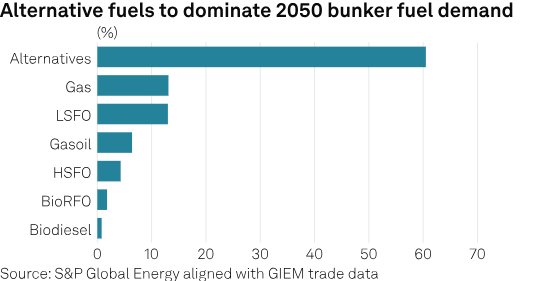
According to an S&P Global Energy scenario in the Freight Markets Bunker Forecast report released in February, overall global bunker demand is expected to be 7 million barrels/day in 2050, with alternative fuels set to dominate.
The GCMD is also contributing to the development of a technical reference document to develop standards for ammonia bunkering in Singapore and is also part of the working group that has commenced work on an international ISO standard for ammonia bunkering, Balani said.
The standards address themes including safety of actual bunkering operations, custody transfers and traceability framework, as well as crew training, said Balani.
“These are the core fundamental layers that need to be addressed before widespread ammonia bunkering becomes possible. So, even if the pricing works out, if we don’t have good standards and a good technical understanding, we will still struggle,” he added.
