


First featured on Ports & Harbours
Thanks to a series of pilot projects, momentum is building behind onboard carbon capture and storage (OCCS), but a complete port ecosystem is still a long way off.
As the maritime sector intensifies its search for viable decarbonisation pathways, onboard carbon capture and storage (OCCS) is drawing great interest, though the industry remains cautious for now.
Yet, as Koh Eng Kiong, director, projects at the Global Centre for Maritime Decarbonisation (GCMD), makes clear, the industry’s central challenge is no longer technical feasibility alone — it is scale, credibility and integration across borders.
“We are seeing OCCS shift from a niche concept towards a more credible decarbonisation option, supported by clearer policy signals and early demonstrations,” he says. “But the industry is still cautious: end-to-end logistics, accounting recognition and commercial viability are not yet certain for broad adoption.”
Recent regulatory developments have strengthened confidence. At the International Maritime Organisation’s Marine Environment Protection Committee (MEPC 83), a formal work plan was approved to develop an OCCS regulatory framework by 2028. In parallel, a working group from the Joint Group of Experts on the Scientific Aspects of Marine Environmental Protection (GESAMP) is advancing lifecycle assessment (LCA) guidelines that include OCCS considerations.
This progress matters, according to Koh: “This is an important signal to shipowners who are likely to consider OCCS when they can see how OCCS might be recognised and accounted for from a regulatory compliance standpoint.”
Clarity on Measurement, Reporting and Verification (MRV), lifecycle emissions accounting and regulatory recognition will send important signals, among many other factors, that will ultimately determine whether shipowners treat OCCS as a compliance tool or merely a marginal experiment.
Project CAPTURED
Technological maturity is also advancing. More providers are piloting and operationalising systems at sea, across both short- and deep-sea segments. Crucially, the industry is now demonstrating not only onboard capture, but also the full post-capture carbon value chain. Again, this is hugely
significant.
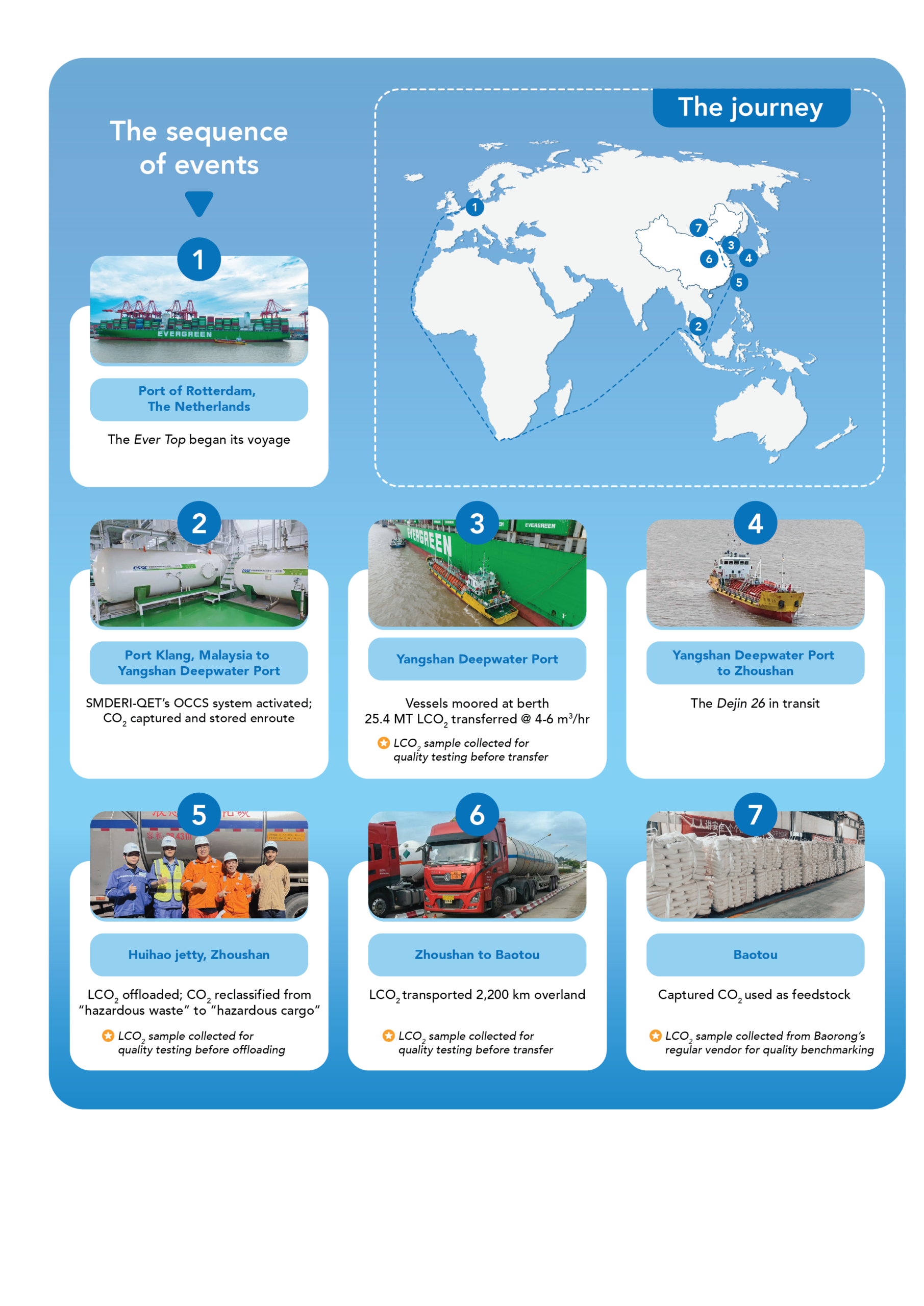
A prominent example is GCMD’s own Project CAPTURED. This initiative demonstrated an end-to-end pathway: CO₂ captured onboard, stored as liquefied CO₂ (LCO₂) in Type C tanks, transferred via ship-to-ship offloading and transported onward to a final user — with emissions savings independently verified.
“While we’ve learned a lot from operationalising this pilot with our partners, its execution also revealed additional technical and operational gaps that need to be closed for OCCS to scale meaningfully such as the importance of reducing energy penalty through waste heat recovery,” Koh notes.
In a separate techno-economic analysis conducted by GCMD on the retrofit of an OCCS system on a medium-range (MR) tanker, other gaps that need to be addressed include shrinking system footprint through compact design and shortening shipyard installation times through modularised units to limit commercial downtime.
The infrastructure question
“Beyond onboard technology and IMO-level accounting, the biggest challenges are end-to-end value-chain readiness, certainty of final disposition and economic viability,” says Koh. OCCS delivers climate benefit only if captured CO₂ reaches certified permanent storage or at-scale durable utilisation, he notes. Storage availability remains uneven, often dependent on cross-border carbon capture, utilisation and storage (CCUS) arrangements that lack alignment on captured CO₂ specifications, accounting standards, permitting and liability frameworks.
Utilisation pathways, while promising, present their own logistical complexities. Project CAPTURED demonstrated a full ‘ship-to-end-use’ chain: 25.4 tonnes of onboard-captured LCO₂ were transferred from a container vessel to an LCO₂ carrier, then moved via ship-to-truck and overland more
than 2,200km to an industrial site, where the CO₂ was used as a feedstock to produce precipitated calcium carbonate and post-carbonated slag.
The demonstration proved feasibility. However, it also highlighted that utilisation demand can become constrained by logistics due to end-users being located far from ports. This underscores a clear preference for siting CO₂ end-users closer to port infrastructure where possible to enable efficient and scalable deployment.
“Furthermore, in many markets, utilisation capacity will first be directed towards domestic captured CO₂ streams,” Koh notes. Onboard captured CO₂ becomes viable only where ports have surplus utilisation capacity or deliberately position CO₂ reception and processing as a service for international shipping. Until then, shipowners face uncertainty over reliable offtake.
Meanwhile, port infrastructure will expand only where a bankable business case exists — offloading facilities, intermediate storage and onward transport systems are all capital-intensive. “Scaling requires infrastructure and commercial pull, not one-off mobilisation,” adds Koh.
Ports as carbon hubs
However, OCCS does not advance in isolation. Shipowners considering retrofits must weigh it against other decarbonisation options, including energy-efficiency measures, biofuels, and emerging zero- and near-zero carbon fuels. While OCCS can complement some of these measures, its bankability is ultimately determined from the shipowner’s perspective, based on capital constraints, operating and fuel costs, cargo-space penalties, the availability of port infrastructure, downstream pathways for CO₂ offloading and permanent storage or utilisation and consistent regulatory recognition within carbon accounting frameworks. “In short, the question is no longer ‘can OCCS work?’ but rather, ‘can we scale OCCS efficiently, safely, and credibly across jurisdictions?’” reasons Koh.
A large part of the answer lies beyond the vessel itself and will heavily depend on ports. With many ports positioning themselves as multi-product energy and carbon hubs, OCCS fits naturally into that evolution. But actual roles may vary considerably. Some ports may specialise as alternative fuel hubs; others as carbon logistics nodes providing CO₂ reception, intermediate storage and onward transport. A smaller number, typically those near industrial clusters or geological storage basins, may support utilisation or sequestration pathways directly.
For captured CO₂, ports can enable adoption in three ways:
1. Provide reliable CO₂ reception/ offloading services (including safe handling procedures and temporary storage), so shipowners can treat CO₂ offloading as a routine port service, much like waste reception or bunkering.
2. Connect ships to the wider CCUS network (aggregation + onward transport to end-use/storage). In GCMD’s concept study to offload onboard captured CO₂, it concludes that intermediate LCO₂ receiving vessel modalities are among the most promising for scale, precisely because they
support aggregation and onward movement for sequestration or synthetic fuel pathways.
3. Drive interoperability across ports by standardising storage conditions/specifications (pressure/temperature/ impurities) and requirements for port reception facilities, and by establishing standards for MRV.
“OCCS creates demand for new port services,” says Koh. If captured volumes reach critical mass, ports with mature safety systems, hazardous cargo experience and strong industrial partnerships will be best placed to selectively integrate CO₂ handling — beginning with containerised pilot solutions and progressing to intermediate LCO₂ receiving vessels as volumes grow.
OCCS: recent milestones
- Seabound, a UK-based leader in marine carbon capture, completes its first full-scale carbon capture systems, which are set to be deployed aboard UBC Cork, a 5,700 GT cement-carrying vessel, following comprehensive landbased testing.
- The first OCCS for a newbuild vessel in China was officially delivered aboard the 82,000 DWT bulk carrier, Shandong Xinsheng, operated by Shandong Shipping Corporation, provided by Shanghai Qiyao Environmental Technology (SMDERI-QET).
- Solvang ASA’s 2019-built ethylene carrier Clipper Eris is the world’s first ship to be retrofitted with a full-scale, operational on-board CCS system developed by Wärtsilä.
- The system, launched in early 2025, uses amine technology to capture over 70% of CO₂ emissions from exhaust gases.
- Damen Shipyards, together with partners including Atal Solutions, completes the retrofit of four bulk carriers for BAM Shipping, including onboard carbon capture systems, among other technologies designed to lower the vessels’ fuel consumption and emissions.
IAPH collaboration
A recently signed memorandum of understanding (MoU) between GCMD and IAPH provides a platform to further accelerate work in this field, according to Koh. “OCCS can be a practical area for collaboration under the MOU, as ports are key nodes to enable the development of the full OCCS value chain” he says.
Through engagement with IAPH members, GCMD hopes to support port-side carbon value chains — including CO₂ reception, interim storage, safe handling procedures and connections to certified storage or credible utilisation.
Equally important is interoperability. The MoU creates an opportunity to align approaches to CO₂ classification — waste versus feedstock — harmonise safety and operational standards, and encourage common technical specifications and MRV practices.
Without such alignment, OCCS-enabled vessels risk facing bespoke arrangements at each designated CO₂ discharging port.
The trajectory is clear: OCCS is technically feasible, operationally demonstrated and increasingly supported by regulatory intent. The remaining challenge is systemic integration — across ports, jurisdictions and value chains.
The question is no longer whether exhaust carbon dioxide can be captured at sea, but whether the industry will build the institutional and commercial architecture to make it happen at scale.
